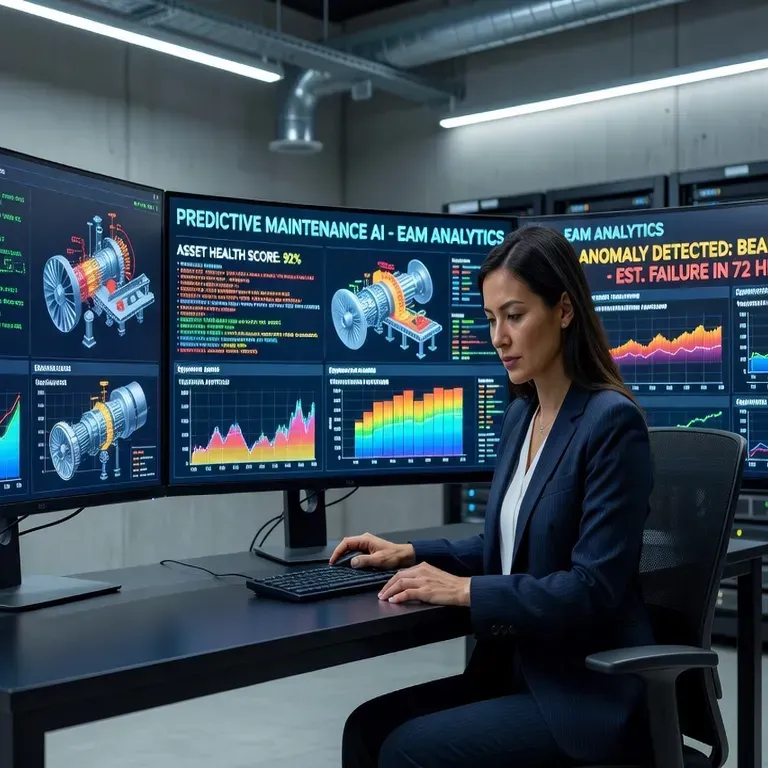
Sarah Mitchell is Director of Asset Reliability at a major North American manufacturing company, where she has overseen maintenance operations and EAM systems for 22 years. Over the past four years, she has led the deployment of IBM Maximo Application Suite with MAS Monitor across three manufacturing sites, integrating IoT sensors with AI-powered failure prediction. In this interview, she shares what she’s learned about making predictive maintenance real — not just a proof of concept.
The Business Case for Predictive Maintenance
Your company has been on this journey for four years. What was the moment that convinced you AI-powered predictive maintenance was worth the investment?
It wasn’t a moment — it was a repair bill. We had a critical cooling tower fan motor fail catastrophically on a Friday afternoon in July. The repair took 72 hours, we lost production, and the total cost including emergency parts shipping and overtime was over $400,000. Our existing PM schedule had serviced that motor two months earlier and found nothing.
After the incident, our reliability engineer reviewed the motor’s vibration history. The data showed a clear signature of bearing degradation starting about six weeks before the failure. We had that data — it was sitting in our historian — but nobody had set up the analysis to catch it.
That failure cost paid for a year of MAS Monitor licensing. The business case was self-evident after that.
For organizations just starting, how do you recommend approaching IoT sensor deployment?
Start with your most expensive failures. Rank your assets by the cost of an unexpected failure — emergency repair cost plus production loss plus potential safety impact. The top 10-20 assets on that list are where you put your first sensors.
Don’t try to instrument everything at once. I’ve seen organizations deploy hundreds of sensors in year one and then struggle to manage the data, tune the alerts, and train the models. They end up with alert fatigue — so many notifications that operators start ignoring them, which defeats the entire purpose.
Start focused, prove value, then expand. We started with 18 sensors on our highest-criticality rotating equipment. After demonstrating measurable ROI in the first year, we scaled to over 200 sensors in year two with a much stronger organizational foundation.
For the Maximo platform context that supports this sensor data, see our Predictive Maintenance & AI guide.
What types of sensors work best for early predictive maintenance programs?
Vibration sensors on rotating equipment — motors, pumps, fans, compressors — give you the most immediate signal. Vibration signatures are well-understood, the AI models for anomaly detection are mature, and the time from anomaly detection to failure is usually long enough to plan maintenance.
Temperature sensors are lower cost and useful for electrical equipment, heat exchangers, and bearings. Current monitoring on motors gives you load profile data that can indicate mechanical problems before vibration signatures appear.
Oil analysis is another powerful predictor — not real-time sensor data, but periodic sampling analyzed by spectrometry. Integrating oil analysis results into Maximo as measurement point readings gives the AI models additional training data.
The key principle is: start with leading indicators, not lagging indicators. You want to detect the conditions that precede failure, not the failure itself.
MAS Monitor in Practice: Sensors, AI, and Workflows
How does MAS Monitor specifically work in your implementation?
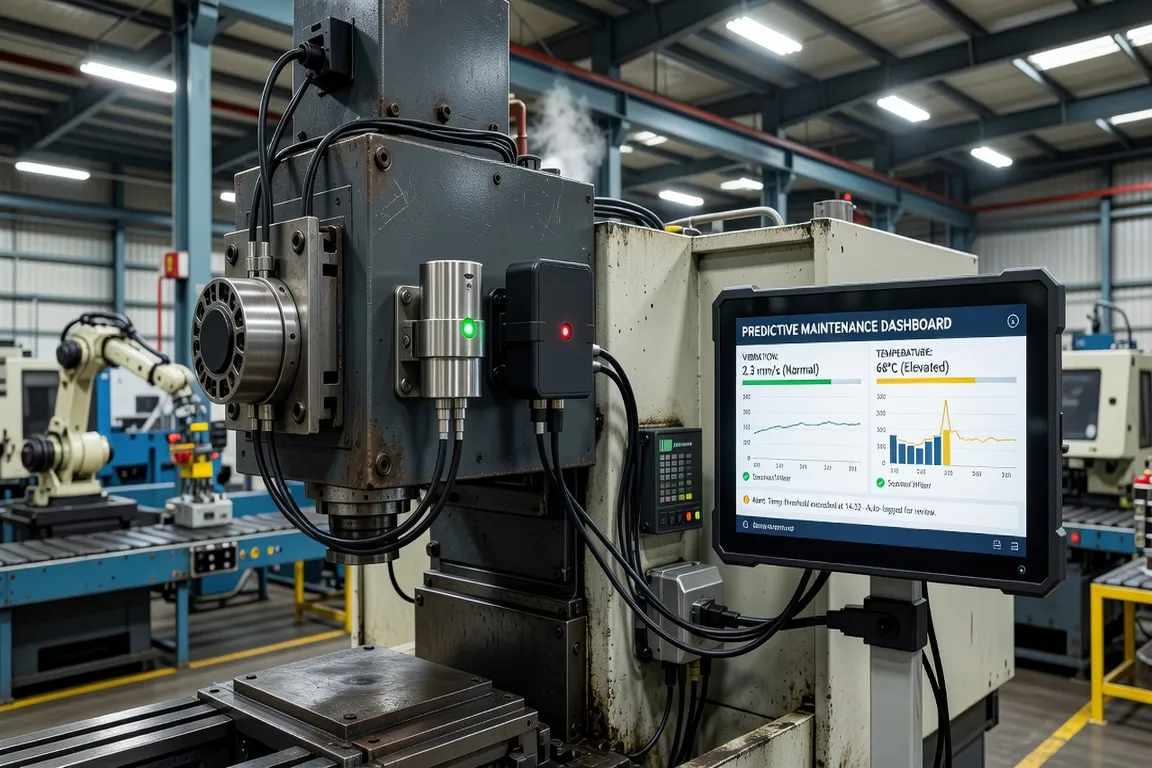 MAS Monitor ingests real-time data from our sensors via IoT Platform connectors. The data flows into MAS as time-series readings linked to specific asset records in MAS Manage.
We’ve configured two types of alerts. The first is threshold-based — if vibration velocity on a specific bearing exceeds a defined limit, MAS Monitor triggers an alert and creates a service request in Maximo automatically. This is condition monitoring, not AI — it’s fast to set up and immediately useful.
The second type is anomaly detection — MAS Monitor’s AI models learn the normal operating patterns for each asset and alert when readings deviate significantly from baseline, even if they haven’t crossed a threshold. This is more powerful because it catches developing problems that don’t yet exceed thresholds. The AI models need 60-90 days of baseline data before they’re reliable, so you can’t use them on day one.
MAS Predict goes further — it uses historical failure data plus sensor readings to estimate remaining useful life and probability of failure in the next 30/60/90 days. We’ve deployed MAS Predict on our most critical asset classes, and it’s enabled us to shift from monthly PM cycles to condition-based interventions. This shift is only possible with well-maintained asset records in Maximo — the AI models need clean asset hierarchy, correct meter readings, and consistent failure code history to train on.
What’s the biggest mistake organizations make when implementing predictive maintenance?
Confusing data collection with insight. Organizations invest in sensors, connect them to a platform, and then generate enormous data volumes — but without the process infrastructure to act on alerts, the data doesn’t prevent failures.
The critical process question is: what happens when MAS Monitor generates an alert? Who receives it? What’s the response time commitment? How is a service request generated and prioritized? Who verifies the alert is valid before dispatching a technician?
If the answer to any of these is “we’re not sure,” your predictive maintenance program will underperform regardless of how sophisticated your sensors are.
We built explicit response protocols for every alert type before we went live with sensors. Alert-to-action time is measured and reported monthly. Our target is under 24 hours for anomaly alerts on Tier 1 assets.
The broader digital transformation ecosystem for industrial AI is developing rapidly — Industrie du Futur tracks Industry 4.0 trends including predictive maintenance integration patterns that can inform your program design.
How do you handle the data science and model management side? Do you need data scientists on staff?
In our first phase, yes — we had a data scientist engaged for 6 months to help configure the MAS Monitor AI models, validate anomaly detection thresholds, and build the MAS Predict failure models for our primary asset classes.
After that initial investment, ongoing model management is handled by our senior reliability engineer. MAS Monitor’s AI framework is designed to be operated by domain experts — it’s not a pure data science tool. You don’t need to write Python code to use it.
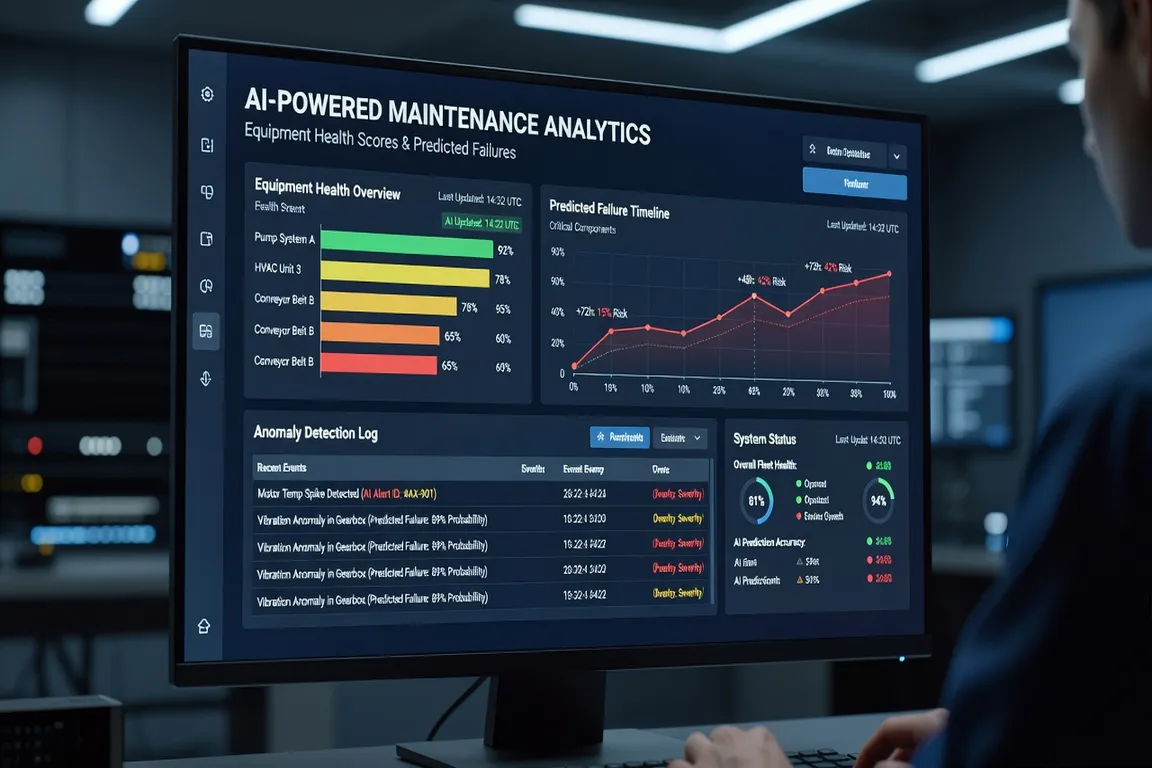 The key skill is reliability engineering knowledge — understanding what normal vibration signatures look like, what failure modes produce what anomaly patterns, how to tune alert sensitivity to reduce false positives. Those are reliability engineering skills, not data science skills.
For organizations without in-house reliability expertise, I’d recommend engaging a reliability consultant for the initial model configuration. The investment in that expertise up front pays off significantly in model accuracy.
Measuring Success and Scaling the Program
What KPIs do you use to measure the success of the program?
We track four primary KPIs:
-
Unplanned failure rate: The percentage of failures that were not detected by the predictive maintenance system. This is our headline metric — we’ve reduced it by 68% over three years.
-
Alert precision: The percentage of MAS Monitor alerts that resulted in a confirmed finding when investigated. Low precision means too many false positives and alert fatigue. We target >75%.
-
Mean Time Between Failures (MTBF): Tracked by asset class. Increasing MTBF means our interventions are catching problems early enough to extend asset life.
-
Emergency maintenance ratio: The proportion of maintenance hours spent on emergency repairs vs planned work. We’ve shifted from 35% emergency to under 12% over four years. That’s where the labor cost savings are most visible.
These metrics connect directly to maintenance cost, production availability, and capital budgeting — the language that finance and operations leadership care about. For tracking these KPIs effectively in Maximo’s reporting tools, the Maximo Reporting Guide covers BIRT report configuration and Start Center dashboard setup.
What advice would you give to an organization starting this journey today?
Three things.
Pick the right first asset. Your first predictive maintenance implementation needs to succeed visibly. Choose an asset with known failure history, available historical data, high failure cost, and accessible sensor mounting points. A success on the right asset builds organizational support for expansion better than theoretical business cases.
Invest in integration with Maximo workflows. The most valuable thing predictive maintenance does is generate timely, actionable work orders. If your MAS Monitor alerts don’t flow into Maximo’s work order system with the right priority, planner, and asset information, the alert is just noise. The integration between MAS Monitor and MAS Manage is critical — get it right in the pilot phase.
Commit to the data. The AI models need quality historical data to train on. If your work order failure codes are inconsistently captured, if your asset hierarchy is messy, if your measurement point history is incomplete — the models will underperform. Before you deploy sensors, spend 3 months cleaning your Maximo data. It’s the unglamorous prerequisite that makes everything else work.
Predictive maintenance is real, the technology works, and the ROI is demonstrable. But it’s not magic — it rewards disciplined, patient implementation.